A Mysterious Journey of Oil and Gas from Hidden Rocks to Everyday Energy
Dr. Md Aminul Islam
Associate Professor of Petroleum Geology and Geophysics,
Department of Geosciences
Universiti Brunei Darussalam
Alumnus and Former Teacher of Geology and Mining
Session: 1983-84
Batch: 9
When we turn on a gas stove or board a bus, we rarely think about the rocks behind that everyday convenience. Oil and gas once occupied tiny pores underground, often kilometres beneath our feet. Reaching us requires years of investigation, difficult decisions and the combined work of many professions.
For the golden jubilee of our Department of Geology and Mining, this journey offers a way to share geoscience beyond the classroom. It begins in ancient sediments and ends in homes, transport and industry, with responsibility continuing after production stops.
A story written in rocks
Much petroleum began as organic material buried with sediment in ancient seas, lakes and deltas. Over millions of years, suitable burial and heating transformed part of it into oil and gas. Some gas also forms through microbial activity at shallower depths.
Petroleum usually fills pores in rock rather than underground lakes. Porosity describes the available storage space; permeability describes how readily fluids move through connected pores. A rock may store petroleum yet release it too slowly for useful production.
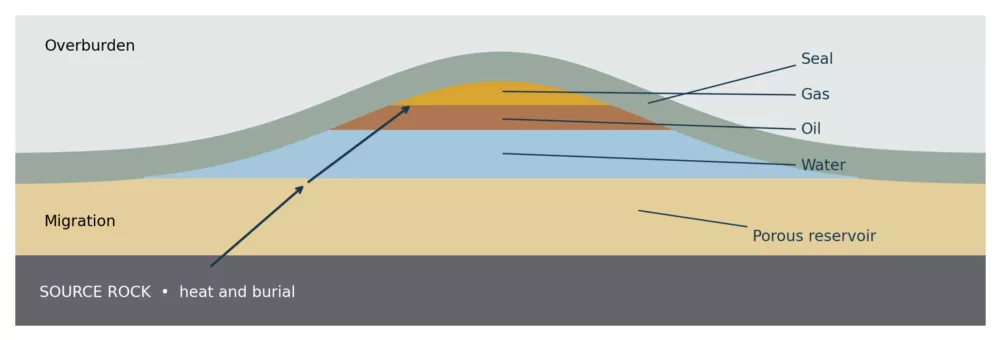
A working petroleum system needs a source rock, migration pathways, a reservoir, a seal and a trap, with suitable burial history and timing. Petroleum moves from its source and may accumulate where a seal prevents further escape. A folded reservoir can provide such a trap. If the trap forms too late, the petroleum may already have passed through.
From a regional idea to a drilling target
Exploration begins with a sedimentary basin. Geologists examine surface rocks, old wells and maps to reconstruct ancient environments. Sedimentologists identify where reservoir sands may occur; structural geologists investigate folds and faults. Fossil specialists establish rock ages, while geochemists and basin modellers assess petroleum generation and its timing.
Within a basin, a play is a family of opportunities sharing similar geological characteristics. A lead is an interesting feature needing more investigation. A prospect is a specific target mapped and evaluated sufficiently to consider drilling. These terms describe growing definition, not guaranteed success. A prospect becomes a discovery only when drilling establishes a significant petroleum accumulation.
Seeing beneath the surface
Seismic surveys send controlled sound waves into the Earth and record returning reflections. Processing converts the recordings into images that geophysicists and geologists interpret. Two-dimensional surveys show individual sections; three-dimensional surveys allow examination of a subsurface volume. Neither provides a perfect photograph or proves that petroleum is present.
Acquisition crews collect the data, processing specialists improve the images, and interpreters map layers, faults and possible traps. Surveyors ensure accurate positioning. The team asks whether the reservoir, seal and petroleum supply are present and whether the trap survived.
Before recommending a well, specialists estimate both the chance of success and the possible quantity if successful. Engineers examine depth, pressure and hazards; economists assess costs and returns. Environmental, community, land-access and licensing work proceeds alongside the science. The decision may be to drill, gather more evidence or stop.
The first well meets the rocks
Drilling turns an interpretation into a direct test. Drilling engineers design the well path, casing, cement and drilling-fluid programme. Geomechanics specialists assess rock stability, while the contractor supplies the rig and crew. The operator coordinates the work and its safety requirements.
As drilling progresses, mud loggers and wellsite geologists examine rock cuttings and monitor hydrocarbon indications. Downhole instruments measure rock properties. Petrophysicists use these logs to estimate reservoir thickness, porosity and fluid saturation. Cores provide actual rock for laboratory testing; fluid samples and well tests reveal composition, pressure and flow behaviour.
Well control is essential throughout. Drilling fluids, casing, cement, pressure-control equipment and trained crews help contain underground fluids. A discovery is possible, but an unsuccessful well can also improve understanding if its evidence is honestly incorporated into the next interpretation.
Appraisal asks whether a discovery can become a field
One discovery well rarely establishes the full accumulation. Appraisal may require additional wells, seismic work, laboratory studies and flow tests. The team investigates the field's extent, reservoir continuity, fluid contacts and the connections between different parts of the reservoir.
Geoscientists and petrophysicists describe the rocks; reservoir engineers examine pressure and fluid behaviour. Together they assess how much could be recovered and at what rate. A discovery may remain undeveloped because it is too small, costly, remote from customers or dependent on unresolved approvals and infrastructure.
How much is there
Petroleum initially in place is the amount originally held in the reservoir. Only part is recoverable. If a hypothetical field contains 100 million barrels and its recovery factor is 30 per cent, recoverable oil would be 30 million barrels. Actual recovery factors vary between fields.
Prospective resources refer to potentially recoverable quantities in undiscovered accumulations. Contingent resources are discovered quantities whose commercial development still depends on resolving conditions. Reserves are remaining quantities expected to be commercially recovered through defined projects under specified conditions. A discovery does not automatically establish reserves.
The cumulative categories 1P, 2P and 3P mean proved; proved plus probable; and proved plus probable plus possible reserves. They must not be added together. Estimates change with evidence, project plans and economic conditions.
Designing a field that can produce
A field development plan joins the underground interpretation to the wells, facilities and transport system. It considers well locations and trajectories, production rates, treatment requirements, environmental measures, costs and eventual closure.
Geologists build a static model of structure and rock properties. Reservoir engineers use dynamic simulation to explore how fluids and pressure may change. These models help compare options, but their forecasts depend on incomplete information and assumptions.
Facilities, mechanical, civil, electrical, instrumentation and pipeline engineers design the surface system. Commercial, finance, legal, procurement and logistics teams make the project workable. Following the necessary approvals and investment decision, development wells and facilities can be built.
Completion engineers equip wells with tubing, valves and barriers for controlled production or injection. Some reservoirs need sand control or stimulation. Construction and commissioning teams install and test the facilities before first production.
From the wellhead to everyday life
A producing well may deliver oil, gas and water together. Separators divide the streams. Oil is treated to meet transport and refinery requirements. Gas may need drying, contaminant removal and compression. Produced water requires appropriate treatment and management. Refineries turn crude oil into products such as petrol, diesel and aviation fuel. Petroleum feedstocks also enter chemical manufacturing. Processed gas can supply cooking, power generation and industrial heat, or serve as feedstock for fertiliser. Pipelines connect many fields to customers; some gas is liquefied for shipment and later regasified. A discovery becomes useful supply only when this delivery chain works.
Keeping the field productive
Production is a continuing investigation. Operators and technicians run facilities; maintenance and integrity teams protect wells, pipelines and equipment. Production engineers improve system performance, while reservoir engineers monitor pressure, fluid movement and recovery.
Engineers compare actual performance with forecasts and adjust models through history matching. The results help assess additional wells, compression, artificial lift or suitable water or gas injection. These measures are field-specific decisions, not automatic stages.
Older wells may develop excessive water production, deposits or equipment problems. Diagnosis comes first. A workover is substantial remedial work, potentially repairing equipment, isolating a water-producing interval or opening another suitable zone. It normally responds to a need during the well's life.
Reserves measure a quantity; deliverability measures a rate. A field can contain substantial remaining gas yet supply it slowly because of poor permeability, falling pressure or limited wells and facilities. Production reduces remaining reserves, while new evidence and changing economics may revise estimates upward or downward.
The responsibility continues
When continued production is no longer justified, wells must be permanently plugged with suitable barriers. Facilities are removed or managed under applicable requirements, and sites restored as required. Closure needs planning and funding long before the last production day.
Some depleted fields may be considered for gas or carbon dioxide storage, but suitability requires a separate assessment. Previous petroleum production alone does not establish safe storage potential.
There is no neat handover where geologists finish and engineers begin. Their work overlaps, supported by technicians, environmental specialists, economists, regulators and communities. Each stage tests earlier ideas and reduces uncertainty without removing it completely.
For our students and alumni, this is a rewarding connection between learning and daily life. A rock sample or seismic reflection may eventually contribute to a household flame or a factory's energy supply. As our department marks fifty years, we can celebrate that contribution while interpreting evidence carefully and using the Earth's resources with care.
Further reading
AAPG Wiki: Petroleum system; Province, basin, system, play, and prospect. SLB Energy Glossary: Appraisal; Development; Workover. Society of Petroleum Engineers: Petroleum Resources Management System (PRMS).