- By Dr. Sirajur Rahman Khan
- First-Batch Student
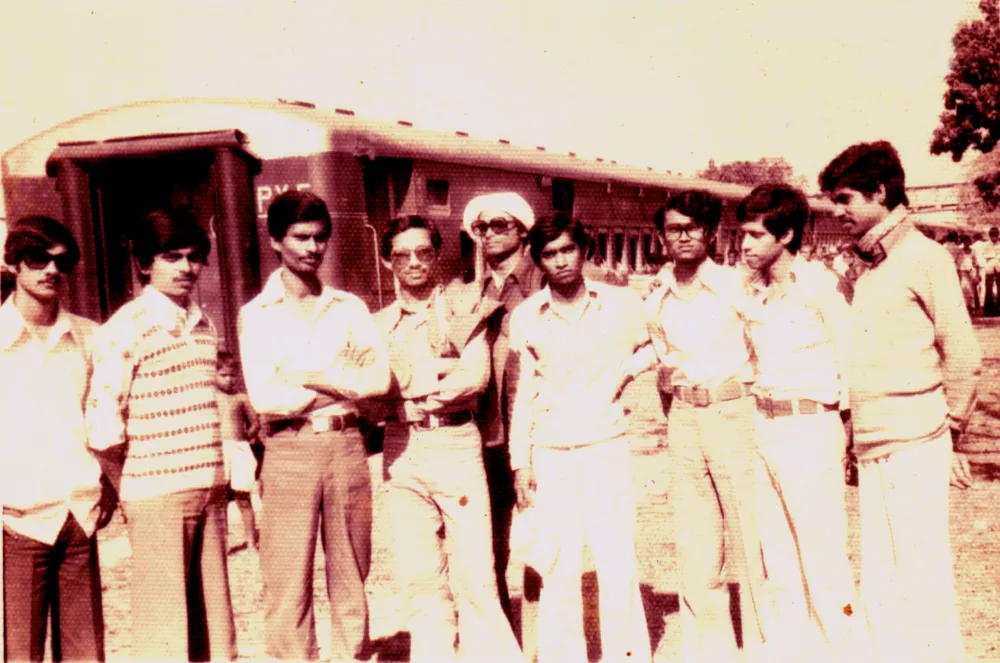
The Department of Geology and Mining at the University of Rajshahi was first established in 1975, occupying five rooms on the second floor of the Second Science Building, known as the ‘Jabir Ibne Hayyan Academic Building’. We, the students of the first batch, numbered only 11, and there were no female students in our class. We were admitted in the middle of 1975. During the first two years, all academic activities were conducted under the Department of Geography. The Chairman of the Department of Geography also served as the head (Chairman) of both departments.
At that time, the department had only two teachers: the late Dr. S. Taher Ahmed and Dr. Aziz Ahmed, who taught all the subjects during the first and second years of our studies. The department became fully independent in 1977, when Dr. Rafiqul Islam, a highly knowledgeable professional from the Geological Survey of Bangladesh (GSB), was appointed as its Chairman. During the same year and in the years that followed, several teachers were recruited, including Dr. Mrinal Kanti Roy, Dr. Hamidur Rahman, Mr. Ashraf, Dr. Habibur Rahman, and Dr. Kamrul Hassan, among others. The department continued to grow and expand with each passing year.
Our first two respected teachers kept us actively engaged in numerous field trips to different parts of the country, alongside an intensive academic programme. Although they were very caring and looked after us as their own children, they maintained strict academic discipline. We had to prepare detailed reports on every field trip, which were thoroughly examined and graded. Our teachers were so strict that there was hardly any room for questioning or challenging their plans. Although we sometimes felt rebellious, we now realise that their approach was perhaps the only effective way to educate students in a completely new and unfamiliar subject.
We faced considerable difficulties during those early years. Only a handful of geology textbooks were available in the university's Central Library. As a result, only half of the students could access the books and take notes at a time. Moreover, those textbooks were not readily available in local bookshops, and even if they could be found, not all of our parents were financially able to purchase the original editions. We therefore had to work extremely hard to prepare our notes and study for examinations. Since there were no senior batches ahead of us, we also had no opportunity to seek guidance from previous students or benefit from their lecture notes.
Despite these limited facilities and the shortage of textbooks, every student in the first batch became highly competitive. The numerous field trips throughout our academic programme, combined with the demanding nature of our studies, helped each of us acquire a strong foundation and considerable knowledge of geology and mining. This knowledge opened up opportunities for us to serve in universities, the Bangladesh Water Development Board (BWDB), and the Geological Survey of Bangladesh with distinction and pride.
The members of the first batch who joined the Geological Survey of Bangladesh upheld the dignity and reputation of the organisation and made significant contributions to its mineral exploration programmes, including coal and hard-rock exploration, as well as the delineation of Bangladesh's maritime boundaries and continental shelf. These contributions helped the GSB earn national recognition and receive the Independence Award (Swadhinata Padak) in 1996. The organisation also received official recognition in 2012 for its contributions to the delineation of Bangladesh's maritime boundaries and continental shelf.
Subsequently, members of the first batch also assumed leading roles in the GSB and participated in several national and international joint-venture programmes in the country. A number of national and international scientific papers were published, and later, we also authored books that contributed to hazard mitigation, extensive geological and geotechnical mapping of the country, and the development of the Blue Economy.
By the grace of Allah, two students from the first and second batches had the opportunity to serve as full-fledged heads of the Geological Survey of Bangladesh (Directors General) from 2013 to 2016. Several other students from these two batches also had the privilege of serving as heads of the organisation in an acting capacity on different occasions.
It is a great pleasure for my wife and me to participate in the 50th anniversary celebration of the department. I wish the event every success. I also pray for the continued development of the department and particularly wish its present Chairman every success in taking this initiative forward and organising the event successfully. My best wishes go to all the respected teachers and staff members of the department.
Fig. 1. The first-batch students are on their way to the Chittagong Hill Tracts for a field trip in 1976. Fig. 2. The same batch accompanied by our respected teacher, Dr. Mrinal Kanti Roy, are carrying out fieldwork in Jaintiapur, Sylhet District, in early 1977. |Figure 3. Students of the first-batch, accompanied by our respected teacher, Dr. Mrinal Kanti Roy, carrying out fieldwork in Kaptai area, Chittagong District, in late 1977.